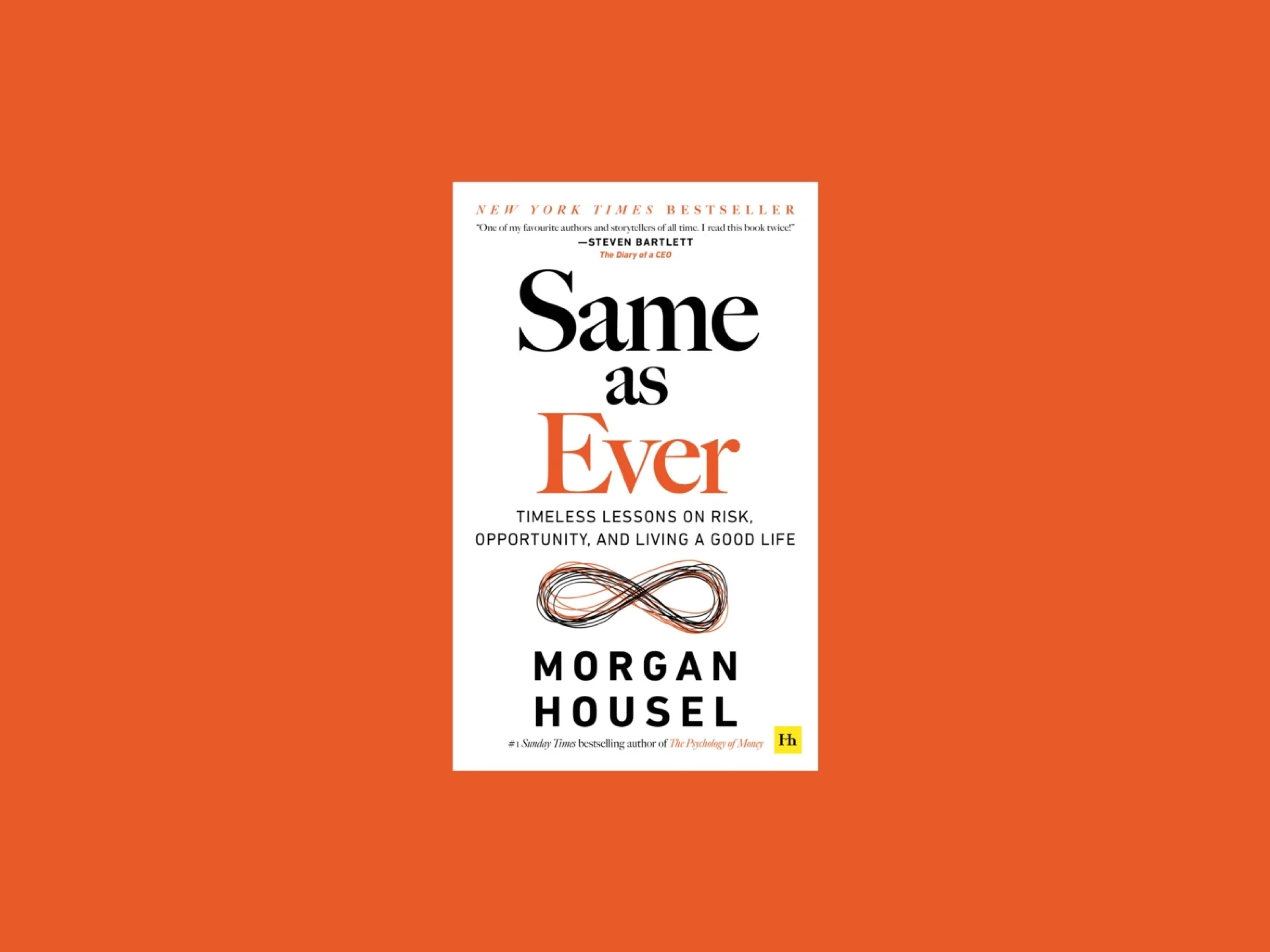
The world changes. Faster than ever. Technologies come and go. New tools, new trends, new buzzwords. As designers we are trained to look forward. To predict. To renew. To innovate.
What if the important thing is not what changes, but what never does?
In Same as Ever, Morgan Housel reminds us of exactly that. The deepest drives in people and in societies — fear, hope, desire, pride, envy, trust — stay the same. However fast the world spins.
A book about what we forget to notice
Morgan Housel does not write for designers. He writes for people. That is why he hits. He shows how we, again and again, underestimate the long consequences of human nature. How we are dazzled by the new, while most of it is really about the old.
He writes about:
Why people will always underestimate risk
Why trust is built slowly and collapses fast
Why we overlook boredom as a danger
Why we never quite learn from history
Why most people do not actually change very much
And above all he writes about the importance of asking better questions, not only finding better answers.
What does this have to do with design?
Everything. Design is not first and foremost about trends, surfaces or typefaces. It is about people. Behaviour. Decisions. Feelings. Same as Ever is useful there. It reminds us of something we easily forget in the chase for the new:
The best design is timeless because it is built on what is timeless in a person.
As a designer it is easy to focus on new technology, new systems, new methods. How often do we stop and ask: what is it that never changes? What are the basic needs we are trying to meet, independent of the form, the screen or the society?
Housel teaches us that there are patterns we can trust, precisely because they are human. Not technological. Not driven by trend. Rooted in how we work as people, alone and together.
A few reflections I am taking with me
Design for trust. Trust is always long term. Design that promises too much and delivers too little dies. Design that builds trust over time lasts.
Understand risk. Users avoid uncertainty. They choose the known over the optimal. Design has to feel safe before it feels clever.
Simplification is not only aesthetics. It is a way to reduce cognitive friction. A path to calm in a complex world.
Universal design is timeless. The need to feel included never goes out of fashion.
Empathy wins. Not because it is trendy. Because it is human. Always.
For you, as a designer
Read this book if you:
Want to understand people better, not only users
Need a pause from trends and methods
Want to make solutions that actually mean something, over time
Want to become a better thinker, not only a better designer
Same as Ever is a reminder of what we already know, and often forget. Most things change, except what really matters.
Maybe that is where we find the strongest foundation for design.