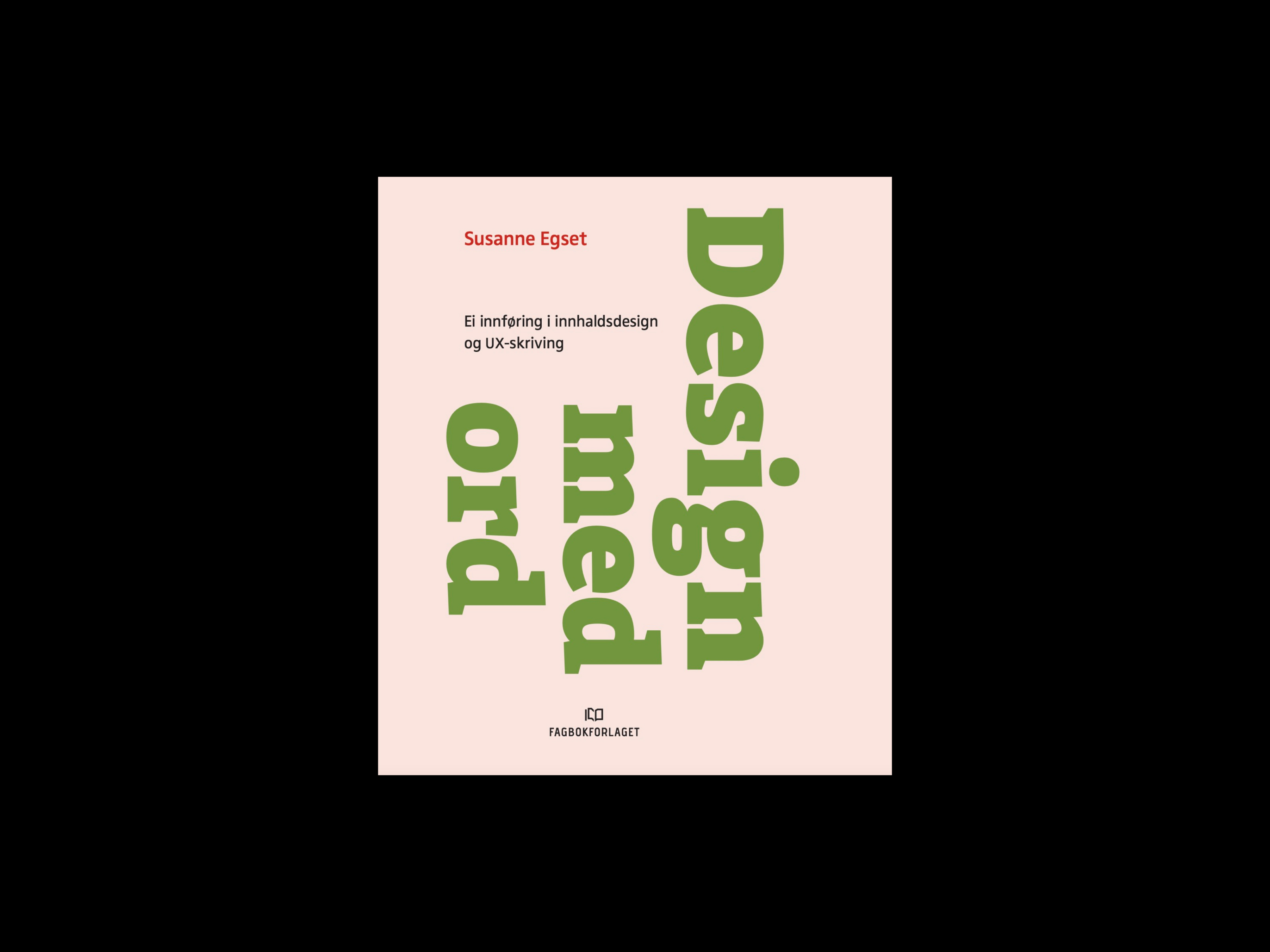
Susanne reminds us of something basic:
“Utan ord har du inga nettside eller digital teneste og ingen app.”
Design is also about words
In daily design work we talk a lot about colour, grid, components, flows, universal design and user journeys. We talk far too little about text. Text is not something that comes afterwards. It is not something the client should “deliver”. And it is not only content.
Text is design. That is exactly what this book is about.
What is content design?
The book introduces content design, which in many ways is the textual sibling of UX design. It is about using text strategically, with the same method and the same thinking we use in good design work:
User insight
Prototyping
Iteration
Working across disciplines
A clear aim, and an effect
Content designers work with microcopy, help text, instructions, navigation, empty states, messages, and everything that makes a digital product make sense, so the user can move on.
Why designers should read it
This book is a gift if you design. Not because it teaches you to write, but because it teaches you to think about text and content as part of the experience. And because it shows how to work better with the people who do write.
It is about asking better questions at the start of a project:
What does the user need to know here?
What happens if this text is misunderstood?
What is the most important thing to say right now?
How do we help the user take the next step?
When you start to see text as a design move, you have a stronger tool. And you become a better designer.
A few concrete pieces of advice from the book
Write so people understand. Do not use internal jargon or bureaucratic phrasing.
Keep the text and the visual design together. A polished UI does not help if the text jars.
Make the content early. If you wait to “fill in the text”, you end up with dummy text and a poor experience.
Think of text as part of the interaction. What are people actually trying to do, and how can the words help?
In short
If you work on digital services, whether that is apps, websites, forms or systems, this book is for you. It shows how words and design belong together, and how you can contribute to better solutions through better communication.
Design med ord does not turn you into a copywriter. It makes you a more conscious designer. Someone who understands that words shape the experience, and that good words are good design.
You can find the book here: designmedord.no